
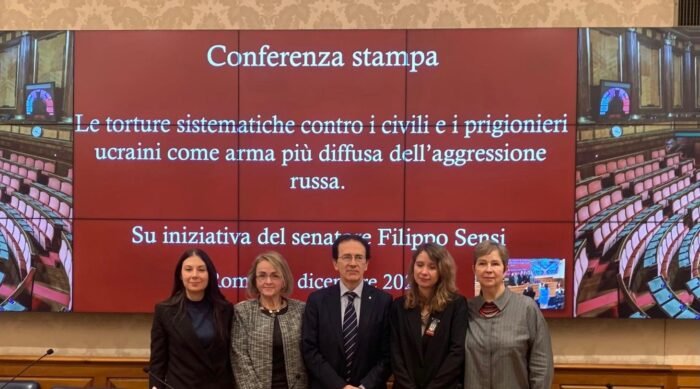
On Friday, December 12th, 2025, at the initiative of Senator Filippo Sensi, the Italian Federation for Human Rights (FIDU) held a press conference at the Italian Senate, in the Sala “Caduti di Nassirya,” titled “The Systematic Torture Against Civilians and Prisoners as a Widespread Phenomenon: A System and a Tool of Russia’s Aggression Against Ukraine.” Organized in collaboration with the Embassy of Ukraine in Italy, the event also featured a screening of an excerpt from Traces, a documentary that sheds light on the human impact of the war through testimonies of sexual abuses, giving voice to survivors and documenting the lasting physical and psychological marks of violence. The excerpt was presented in person by the film’s director Alisa Kovalenko, together with Iryna Dovhan, linking the film’s narrative to the wider call for truth, justice, and accountability discussed during the conference. Key takeaways from the speakers’ interventions included the following:
Sen. Filippo Sensi opened the conference by stressing that political action cannot stop at declarations: it must be followed by justice and accountability. He framed survivors’ testimonies not as distant “stories,” but as a form of living memory and resistance: women who speak out to affirm that they exist, despite indifference and the tendency to look away when suffering happens far from us.
Moderated by Antonio Stango (FIDU), the event combined documentation, testimony, and advocacy, including the screening of an excerpt from Traces.
Director Alisa Kovalenko (European Film Academy / Ukrainian Film Academy) explained that the film is also intertwined with her own experience. She recalled traveling to Donbas in 2014 to document events and being taken prisoner and abused during interrogation. She described how sexual violence has long been surrounded by silence – how many survivors, including herself, initially chose not to speak out – and how fear and public judgment can become a second prison. Kovalenko emphasized that Traces was created to protect survivors’ voices from being erased, showing how sexual violence, imprisonment, and torture leave long-lasting physical and psychological traces. She argued that testimony is not only a record of pain, but also an act of agency: when people cannot fight at the front, they can still defend truth by speaking. The film’s excerpt, introduced with Iryna Dovhan, connected individual stories to a wider warning about the dangers of “forgetting” or normalizing such crimes through political compromises.
Iryna Dovhan (SEMA Ukraine) reinforced that fear and stigma have historically paralysed victims and delayed recognition, especially in smaller communities. She described the difficult work of building trust among survivors and insisted that institutions should not wait for numbers to become overwhelming before treating sexual violence and torture as central, not secondary, war crimes. Her message was clear: silence empowers the aggressor, while support networks and international attention make it possible for victims to speak and to seek justice.
Maryna Mukhina (journalist and human rights activist at IPHR) presented findings from recent documentation work on detention conditions for women in occupied areas. She highlighted patterns repeated across testimonies: violence that is physical and deeply psychological, sexual abuse combined with torture and threats, humiliation used to dehumanize, and intimidation designed to break a person’s sense of self. Her conclusion was that these are not isolated incidents, but practices that appear coordinated and systematic.
Oleksiy Sivak (ALUMNI), speaking from the perspective of a network of civilians who have suffered torture, described occupation as a constant hunt for civilians, people taken from homes or checkpoints, held in improvised or permanent facilities, and tortured to force compliance and instil terror. He underlined that similar methods recur across different regions, suggesting organization rather than randomness. He also argued that the war targets civilians broadly, including through destruction of infrastructure with no direct military value, and noted that documentation is being shared with international justice mechanisms even as the path to accountability remains slow and obstructed.
Olesya Tataryn (Italia–Ucraina MAIDAN / SEMA Italy) emphasized that sexual violence and torture are aimed not only at individuals, but at a people’s future, attacking identity, continuity, and the social fabric itself. She called for clear condemnation of these crimes and for effective international mechanisms to deliver justice and reparations, including concrete measures that make accountability credible.
In closing, Eleonora Mongelli (FIDU Vice President) reaffirmed the systematic character of torture and sexual violence and insisted that acknowledgement is the first step toward any serious response. She warned against narratives that would “rehabilitate” the aggressor’s image or trade accountability for political convenience, arguing that amnesty for serious crimes cannot be accepted and that victims’ voices must remain at the center of public debate.
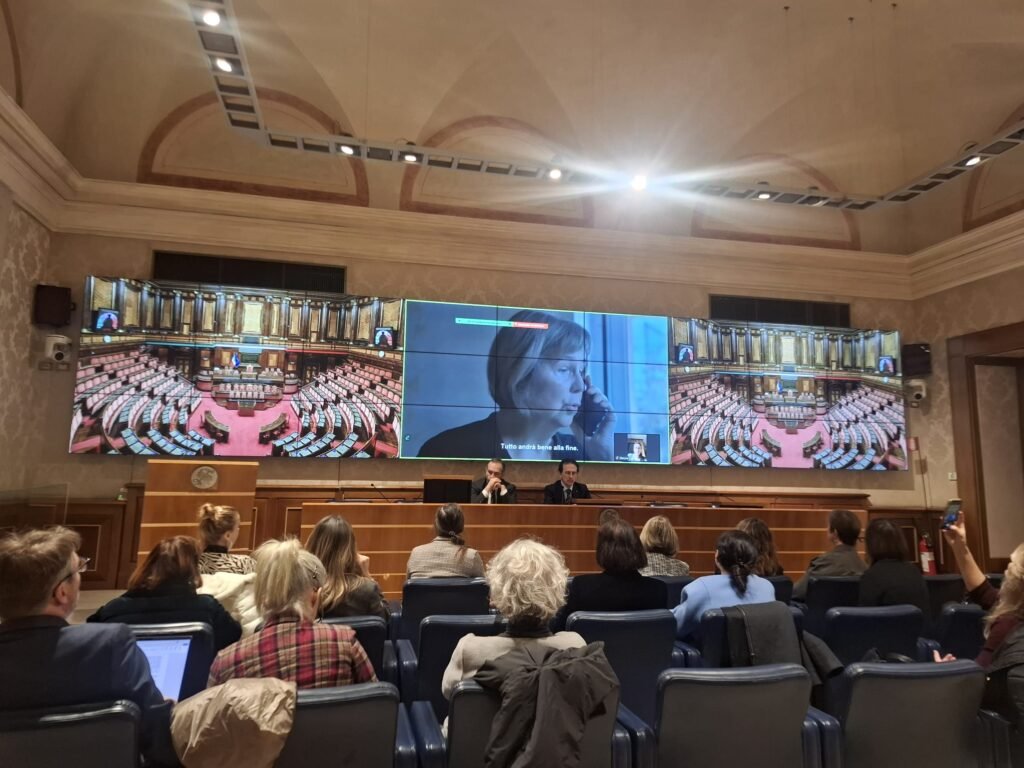
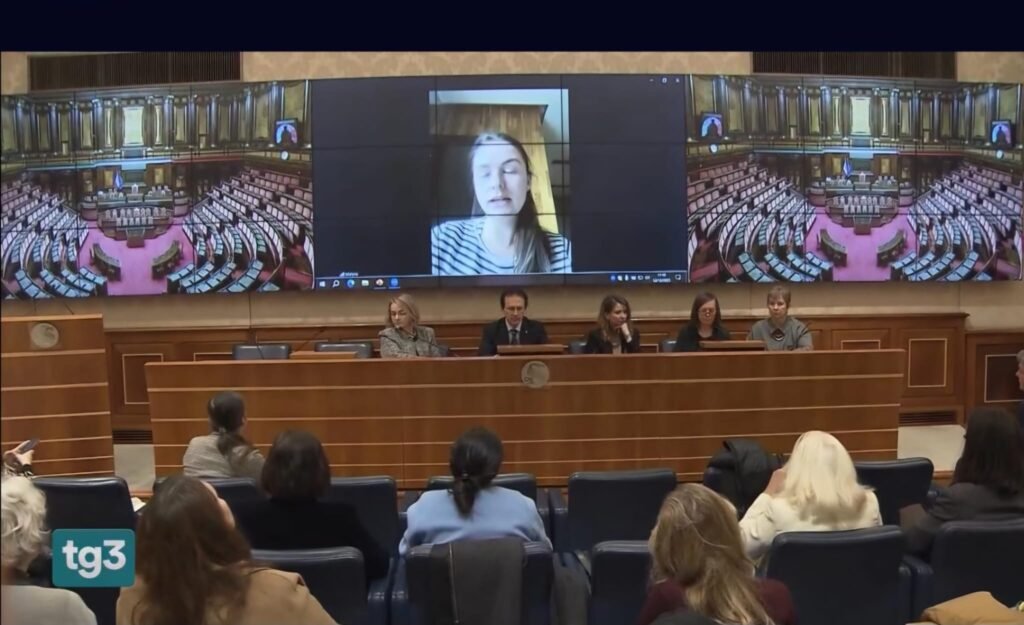
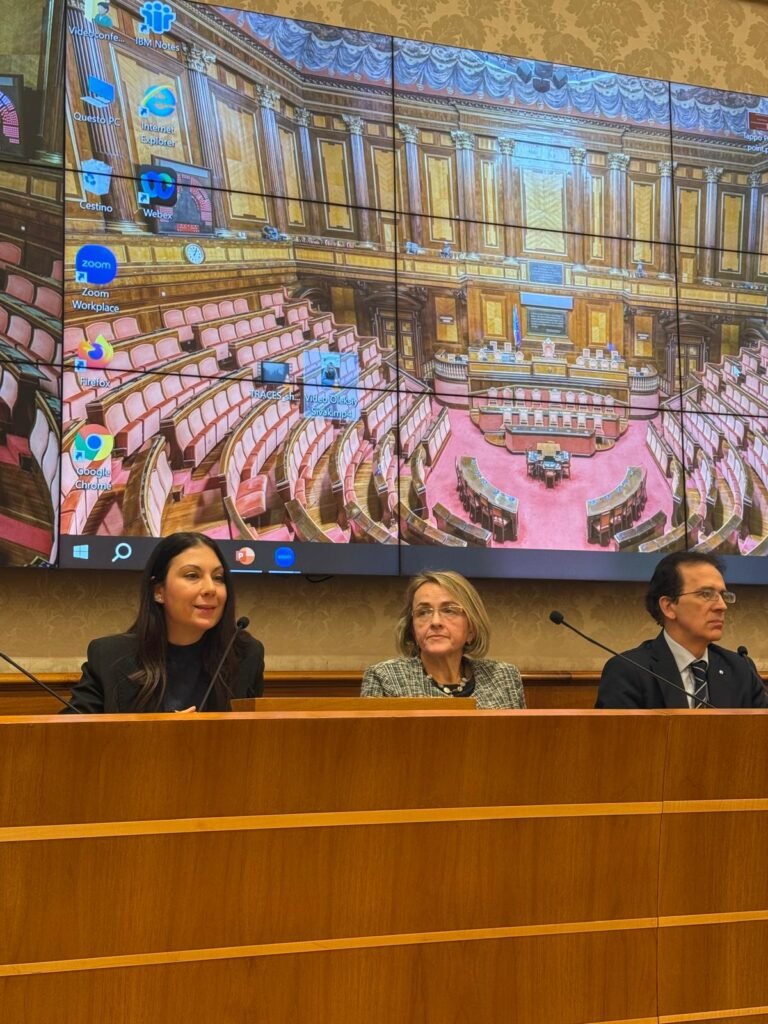
The video recording of the conference is available here